Oct 212007
 

Adam Sleek spelade musiken från The Partridge Family oavbrutet när Shaun Partridge besökte honom 1988. I början var han irriterad på sin värds sätt att stirra på honom medan han sjöng med i varanda ord, och att vakna upp till samma låtar varje morgon. Men efter ett tag insåg han att, nämen hejsan, det här är ju bra musik. “I had the revelation that the people in The Partridge Family were the gods and goddesses you read about in school. They’ve been around since the beginning of time, but they had different names in different ages. And in 1970 they decided, `Hey, let’s get a hit TV show.'”

Men templets medlemmars speciella relation till TV-apparaten handlar det här dock om mer än en nutida manifestering av Jungs eviga arketyper. Med hjälp av droger och tålmodigt mediterande framför dumburken kan inkännandet i tv-världen intensifieras.

“Our religion is the perfect religion for the new millennium. The television is our god. Our symbol is the eternal CBS eye. Everyone worships TV. We’re more real than Christianity. You can turn on your TV and see our religion”.

“I was really drunk on Jack Daniel’s and I was just calling people nerds and this girl attacked me. Some guy got punched in the face. Stuff like that does happen. Stupid drunk chaos is a part of people’s lives.”

“I’ve always liked the kind of experimental theater where the audience is also involved. That’s why I would go out and yell things, to try to involve everyone in the excitement.

Psykogeografi kan mycket kort och enkelt ses som produktivt felanvändande, vare sig det handlar om stadsplaneringen, parkbänkarna, gatunätet, eller ny, hipp teknologi. I Richard Linklaters långfilm Slacker möter vi bland andra nörd-existenser på drift en ung man som låter sin tid domineras av ett aktivt, nyskapande tv-tittande. Han har inrett sin lya med maskin efter maskin uppstaplade mot väggarna, alla påslagna, alla inställda på olika kanaler. När han frågas vad som pågår svarar han löst om att han skapar ett slags strålningsfält, ett harmoniskt system, “det håller på att ta sig nu”, det är något hittils okänt han söker i felanvändandet av tekniken. Man påminns om David Cronenbergs Videodrome. Kanske handlar det om en lägenhetsinstallation (en parallell till Kurt Schwitterz, och neoisternas lägenhetsfestivaler).

Copyriot skriver då och då om långfilmens död och det har man rätt i. Man bör se bara slutet eller de saftigaste bitarna, långfilm, kort sagt långdraget. På biografen saknar vi fjärrkontrollen, framför tv-apparaten saknar vi tangentbordet. Vi gillar vad vi ser i TV-serier som laddar sig upp och ner i nätet i en slags folkförflyttelse och mytologisk väv, nu när TV-skärmens otroliga, psykedeliska kraft och kraftiga organisationsförmåga blandas med datormaskinens läs-och-skriv-möjligheter och platta nätstruktur och ännu plattare skärm.

The Dreamers är historien om två incentuösa syskon och deras förtappade amerikanska vän som lever en bohemisk och hedonistisk, filmhistorisk drömtillvaro i syskonens luxuösa familjevåning i Paris under några veckor i maj 1968. Den förslutna smågrupptillvaron utvecklar såklart snabbt sin misär, sin svartsjuka och sitt integrerande, och fransosen är en maoistiskt föräldrarevolt och amerikanen en naiv romantiker som båda gillar sina klichéer. Vad som istället är intressant är hur nära dessa ungdomar har till att leva ut favoritscener från sin filmkonsumtion (en impuls som får utlopp i ett slags Gissa-Filmen-Sanning-Eller-Konsekvens-spel). Detta blir det viktigaste för dem, och filmens hjärta. Från majrevolten i sig syns inte mycket, men det visas med all önskad tydlighet att utvalda filmscener kan fungera som instruktion i vapendragning.

Oct 212007
 

Björk är det kvarlevande renässansgeniet, den senaste myten om den ensamma och mångsidiga konstnären. Hennes gestalt tecknas tydligt i en intervju med Aphex Twin där musikern berättar att hon länge velat arbeta med honom, att hon skickat dit advokater för att underteckna kontrakt, osv. Men för honom fungerar det inte så, för att han ska göra nåt med en annan artist måste de titta förbi först och röka en spliff och dricka tjugo koppar té; han föredrar helt enkelt att göra musik med sina vänner.

Aphex Twin är en av dessa stora, varma ironiker som ser vänskap som grund för allt verkligt skapande. Även om Björks senaste erbjuder oss några riktigt heta spår (som Declare Independence och The Dull Flame Of Desire) lyssnar vi längre och mer innerligt på Aphex Twin.

Skapande är inte ensamhet, men vänskap.

Oct 162007
 

“I am the camera’s eye. I am the machine that shows you the world as I alone see it. Starting from today I am forever free of human immobility. I am in perpetual movement. I approach and draw away from things–I crawl under them–I climb on them–I am on the head of a galloping horse–I burst at full speed into a crowd–I run before running soldiers–I throw myself down with the aero planes–I fall and I fly at one with the bodies falling or rising through the air. “

Oct 102007
 

På extramaterialet till A History Of Violence säger Cronenberg att han först tyckte att manuset var mainstream, men att han med tiden fick för sig att han kunde göra nåt eget av det. Och så blev, en tv-movie med halv-intressant psykologi och återhållsamt Cronenberg-slafs. Han borde kunnat hitta nåt hetare material att lägga ner tid, energi och såna fina grejer på.

Bland alla klassiska superhjältar är det egentliga bara Batman som fångat mitt intresse. Som barn såg jag Adam West lysa varje vecka i TV-mediets fulla strålkraft, och jag läste de klassiska seriealbumen, för att senare avnjuta Tim Burtons filmatiseringar. Idag såg jag Batman Begins, efter att en vän berättade att denna filmatisering fokuserar på Batman-historiens mörkare sidor.

Medan de två första filmerna ger oss en något sentimental och teatralisk Batman-tolkning (som vanligt med Burton) uppehåller sig Nolan vid föräldrarnas död och de vedergällningsplaner som driver den unge Bruce Wayne i sin metamorfos från dyster rikemanspojke till fullvuxen läderlapp, allt kriminellt slödders obevekliga hämnare.

Historien läggs fram på ett sätt som kanske inte är trovärdigt i eran verklighet, men som stämmer väl överens med Batman-universumets inre logik. Regissören frågar sig hur man kan drivas att dedikera hela sitt liv och alla sina resurser till brottsbekämpning, och göra om sig själv till ett namn, en legend, en symbol.

Den unge Bruce spenderade sina år efter studietiden med att resa världen runt för att lära känna den kriminella mentaliteten. I Kina träffar han på ett hemligt sällskap som ger hans liv riktning. Sällskapets kärnideologi är svårgreppbar, men det som driver dem verkar vara en allmän trötthet på storstädernas dekadens, “människor är inte menade att leva på detta sätt“. Denna grupp lyckas dock inte förse vår hjälte med en särskilt avancerad analys av brottslighetens mekanismer, något som filmen också skickligt exponerar i en nyckelscen. När Bruce återvänder till Gotham efter sina resor besöker han gangsterbossen Falcone det första han gör, för att konfrontera mannen som håller staden i ett järngrepp och visa honom att alla inte står skrämda till tystnad och apati inför hans väv av korruption och våld.

Där får han veta att han inte känner till den värld som Falcone representerar. Tror han, bara för att hans mamma och pappa mördades, att han känner till ordet desperations verkliga innebörd? Hur har hans vittnesbörd nån bärkraft? Tror han verkligen att hans ilska är giltlig inför allt detta samhälles smärta, smuts och misär?

Att glömma den sociala biten är fatalt, och hans miljardärföräldrars välgörenhetspatos förgrovas i en personlig nolltolerans. Gotham Citys Alva och Gunnar Myrdals socialliberalism maskeras om med den ensamma aktörens moralkonservativa drag, och resultatet är kladdigare än lille Janne Myrdals föräldrauppror. Det är solklart att Wayne är fucked up mentalt sett, hatet och hämndbegäret genomsyrar hans tankevärld och känsloliv och definierar hans mål och handlingar, och man kommer att fråga sig var gränsen går mellan superhjälte och terrorist.

Denna gotiska seriositet paras med ett väloljat Hollywood-maskineri, som spinner på i fin balans mellan sjysst foto, fräscha specialeffekter och välinoljade skådespelargudar som Michael Caine, Rutger Hauer, Morgan Freeman och Gary Oldman (med Katie Holmes som representant för nyhollywoodsk talanglöshet).

Det enda sättet som Batman Begins skulle kunna gjorts ännu bättre vore (förutom att byta bort Katie Holmes mot vem eller vad som helst) att låta David Cronenberg regissera spektaklet.

Sep 262007
 

Erik Satie höll nog tungan jävligt rätt i mun när han för runt ett sekel sedan skrev om en framtida möbelmusik. Men trots den absurda söndagskrönikestämningen i Saties noteringar finns det nåt att dröja kvar vid här.

I viss mening kan möbel ersättas med hiss, och i detta sammanhang intar Kraftwerk en rent reaktionär position.

Hissmusiken hjälpte konsumenter att konsumera mer, men också en ny sorts musik på traven. Konsertformen och den passivt andaktiga, uppmärksamma lyssnaren fick konkurrens. Brian Eno släppte sin flyplatsplatta, och trettio år senare lyssnar jag nästan uteslutande på en slags aktiv bakgrundsmusik, en bruksmusik som är funktionell likt möblemanget.

På samma sätt som Satie föreställde sig en musikmatta som skulle fylla ut tomrummen i ljudmiljön och fungera som en auditiv skyddsbarriär mot besticksslammer och människoröster, så använder jag dub-house, minimalistisk techno och ambient för att neutralisera skrikande bildäck, reklamhögtalare och djungelvrål från störda individer utanför mitt vardagsrumsfönster.

Sep 202007
 

“It was in this ocean current that the Nautilus was now navigating. On leaving the Bahama Channel, which is thirty miles wide and more than a thousand feet deep, the Gulf Stream flows at about five miles an hour. This speed decreases steadily as it goes north and it must be hoped that this regular trend will persist, for should its speed and direction be changed, the climate in Europe would undergo an upheaval of incalculable consequences.”

Climate-changes of “incalculable consequences”? Sounds like a definition of global warming. Jules Verne predicted that on page 351 in Twenty Thousand Leagues Under The Sea about 138 years ago.

When I go on reading and he starts explaining how electricity would work in the future I can understand why Bruce Sterling holds him as one of his biggest influences; here you’ll find the same healthy obsession with telling straight stories of high weirdness and scientific inventions that defines anything good by Sterling, and the well-bred, adventurous protagonists seem to spring from the same technological optimism (there’s nothing corny about that optimism, to me Verne and Sterling (together with Tesla, Newton, Fueller and others) represent a kind of rational, corrosive thinking that has made this planet a better place to live on, and which I thankfully count among the characteristics of the human organism).

In our times world science has gone through a degenerative stage; seldomly is the imagination of the masses teased by perfect weapons and bombastic underwater vessels as in the time of Jules Verne and Alfred Jarry. They find life on Mars, increasingly powerful telescopes are charting the properties of fucked-up planets really far away, even brazilians are floating in space, and nobody gives a fuck. Some of this is of course Sterling’s fault. In the 80s he and his comrades in the armed revolutionairy cells of classic cyberpunk helped to reintroduce a technological optimism that had been missing in popular culture since the Space Race of the 60s, but as a contrast to the Babel-works and Whitey On The Moon-adventures of the past, they left the reader on a microscopic, continually mutating DIY-horizont. (Who could, in the shadow of Kamikaze cold war capitalism, know that it was, just like in Terminator 3, the radio amateurs who would inherit the earth?) Looking at the big picture, you can see that the macro-applications of Vernes age disappeared from the field of SF.

But was Verne really all that different from the iconoclasts of recent history? According to Sterling, no:

“It might, for instance, be argued that Jules Verne was a nice guy who loved his Mom, while the brutish antihuman cyberpunks advocate drugs, anarchy, brain-plugs and the destruction of everything sacred

This objection is bogus. Captain Nemo was a technical anarcho-terrorist. Jules Verne passed out radical pamphlets in 1848 when the streets of Paris were strewn with dead. And yet Jules Verne is considered a Victorian optimist (those who have read him must doubt this) while the cyberpunks are often declared nihilists (by those who pick and choose in the canon). Why? It is the tenor of the times, I think.”

In Twenty Thousand Leagues Under The Sea Verne both bores and fascinates us with endless listings of the sea life peculiarities that meet the visitors aboard Captain Nemo’s Nautilius, but the heart of story of the story is the ship itself and its enigmatic captain, a man who sees a necessity, not in new continents, but new men, “nautical towns, clusters of submarine dwellings which, like the Nautilus, would rise to the surface every morning to breathe – free towns, independent cities, if ever there were!” (A comparison with Stephenson’s marine platform clusters in Snow Crash could be at its place here. More interesting than to see this book as a revered classic – a piece on a museum – is to see it as a still vital source for ideas and fantastic impulses. That’s the way it must have been viewed by Robert Anton Wilson; Hagbard Celiné from the Illuminatus-trilogy reminds us more than a little of Captain Nemo.)

As I read about intricate coral reefs, giant jellyfish, sunken ships frozen in time at the ocean floor, the majestic icebergs of the poles, societies of walrus, immense species of whale and the menacing, perfectly built killing machines known as sharks I can’t help but once more think about the sea these days and the weird, rapid changes that must be taking place in its waters due to global warming. SF will surely have reasons to visit the seven seas more frequently in the future.

Sep 172007
 

Vår blick för anti-politisk inspiration har vanligtvis legat bortanför vattnet, men Gyllene Flottan är ett gäng som alltid är välkomna på ubåten när vi rör oss mot den nord-västra passagen.


(Ungdomar, lyssna, att säga nej till TRÅKSOCIALISM är lika viktigt som att säga nej tiller CRACK.)

Den rotlösa kommunistungdom som förlorat sig i populärkulturen och den blog-verksamhet som intresserar sig för post-situationisk teori bör uppmärksamma Gyllene Flottan som en av sina nära föregångare. De var inte perfekta, men några saker gjorde de rätt. När Jan Myrdal reste runt i Kina och klädde sig som en arbetare och resten av landet var insyltat i auktoritär proggsmörja översatte dessa hjältar texter ur Internationale Situationniste och gjorde sin egen kritik av svenskt studentliv, och idag när Myrdal skriver vinkrönikor och nationalistpropaganda är namnen bakom Gyllene Flottan fortfarande höljda i fruktbart mörker.


Deras främsta förtjänster var dock varken teoretisk mognad eller förakt för författarnamnkulten; vad som mest lockar mig till att dröja kvar här är den närhet till populärkulturen som genomsyrar deras publikationer. När jag tittar igenom de få utgivna bladen ser jag ledare undertecknade Astro-pojken och Stålflickan, och James Bond-omslag och – vackrast av allt – på försättsbladet till Livets rum och tid, en seriealbumsastronaut och undertiteln “Hela universum är utlämnat åt arbetarrådens plundringståg“.

Kontrasten till dåtidens progg och stalinistiska kultursyn är enorm. Wu Ming säger:

“I think that if you don’t know pop culture, you don’t know your culture, thereby you don’t know the world around you. If you don’t know shit about pop culture, how can you be on the cutting edge of anything? If you don’t soil your hands with pop culture, if you snub and sneer at today’s participatory culture, you can’t be “avantgarde”, no matter how hard you try.”

Än idag är Gyllene Flottans individuella beståndsdelar okända för allmänheten. Kanske bäst så, mina personliga spekulationer rörande lyckliga, solskenskäcka livsöden och försvinnanden in i sprit, trav, heroin och resfeber duger gott för mig.

Aug 272007
 

This is my first post in english – hopefully there will be more in the future.
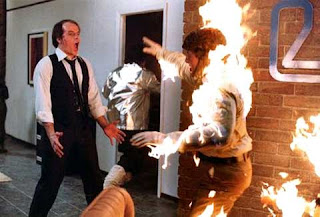
Whether we are talking about a telekinetic splatterfest in a shopping mall food court, a vagina-like slit opening up in your stomach and swallowing your gun and your video-tapes, or just a dose of some good old car crash-sex, Canadian director David Cronenberg is responsible for some of the most brain-bending moments in cinema. Many of his movies concentrate on a fear of bodily transformation and infection, and therefore it is reasonable to talk about him as a maker of Body Horror-movies.

The theme of graphic descriptions of diseases and mutations turning human beings inside out was established in Shivers from 1975. In the BBC-documentary David Cronenberg And The Cinema Of The Extreme the director tells us that he “wanted to have a kind of claustrophobic, trapped feel, and there was something about a high-rise apartment building in which little dramas were unfolding in each apartment. I wanted to suggest that the proliferation of this strange disease was on one strange level liberating, and that gives the film I think its very disconsertive feel.”

To this zombie-maestro George Romero adds in the same documentary that “it’s really part of the job of the genre to rattle your cage and to create an environment that is not the environment that you’re in, it’s not the world, it’s meant to shake that world up, particularly if you’re using it as some form of criticism of the ways things are. The big problem I’ve always had with normal horror is that things are restored to normality in the end, whereas the whole genre is meant to bring down reality or destroy it.”

Cronenberg went on to direct many conceptually interesting and culturally significant movies throughout the seventies, eighties and nineties. The gore-remake of the classic The Fly is for all its broken eighties logic and dated dialogue and special effects an enjoyable two hours of popcorn-magic. Who better to remake this fifties classic of extreme science and bodily mutations than Cronenberg? And who could have been more fitting for the adaption of William S. Burroughs underground classic Naked Lunch to the silver screen? Here it is perhaps better to talk about mutation rather than adaptation, since the idea of sticking to the story in the book is wisely thrown away. Such a treatment would after all – according to the director – “cost 500 million dollars and be banned in every country of the world”. Instead we get a movie where episodes from Burroughs personal life as a bug-exterminator in New York City and as an expatriate in the lawless, drug-filled Interzone in northern Africa are mixed with dusted segments of typewriters turning into giant, slimy cockroaches and sadistic female nazi-officers interrogating him about who knows what.

In eXistenZ the reality matrix is distorted when players enter a deadly Virtual Reality game, without an idea of when they get out, or if they even can. The bad acting and technical glitches of certain video games are here taken to a higher level, and it is all fun stuff and weird moments. Crash, based on a novel by J.G. Ballard, tells us about a group of people with one thing in common, they all get really turned on by car accidents. The hot date between man and machine is yet again explored from an unexpected angle.

In the end, these are all more interesting to talk and write about, than to actually watch. All are fine, enjoyable movies, but none of the mentioned have the attractive low budget-qualities and the perfect narrative synthesis between sex, gore and brain that we find in three movies from 1979, 1981 and 1983 – The Brood, Scanners and Videodrome.

The Brood details the unorthodox practices of a pychotherapist who encourages his patients to let their mental problems run amok on their bodies. A man who is verbally abused by his father develops welts on his body as a manifestation of his pain, and another patient develops lymphatic cancer as an expression of his self-hatred. The main character wants to rescue his pregnant wife, who is undergoing intense treatment at this clinic, and the rest is an impressive seventies mess of mutations, gore and motherhood. This movie has a wonderful seventies grindhouse-feel, and several strong scenes you are unlikely to forget. The seventies was after all the golden, alchemical age of horror movie-making, where the amateur gore turns into an image of worship – a way out of this shallow world of our fixed senses, a bad performance is expanded into an unforgettable slice of low-life, and the drunk camera gives a point from which to view the world that is beyond both hyperrealism and surreality.

Image of worship is meant as a part of the pop culture trinity Gore-Data-Sex, which dominates our screen society as a glimpse of that other world which is beyond our fixed senses. Meditating, contemplating in front of the image of death, in front of life’s shortness and fragility is the third, final way out of the prison of self, the first being sex; the union of bodies in orgasm as we are transcending and forgetting ourselves, in the way that Bataille describes in Eroticism. The second is the union of flesh and machine, where the self is forgotten in an intense, concentrated marriage with computers, samplers, synthesizers, editing equipment, photographic machines, etc.

Mutilated bodies – representing death – is a sacred image, watching gore-flicks is the ritual. What is the disintegration of our bodies, if not a union with the body that is beyond our finite senses, the Mind At Large, “that Other World which lies at the back of every mind” that Huxley talks about in his The Doors Of Perception and Heaven And Hell?

Scanners are people with extraordinary telpathic and telekinetic abilities, sought after by ConSec, a company specializing in weaponry and security systems. Being a futuristic thriller with lots of action, beautiful gore, and all the evil corporations, dangerous technology and doomed bodily transformations demanded by the genre, this was Cronenbergs biggest commercial success until The Fly, six years later.

Both The Brood and Scanners have their eye-popping moments that will impress even the most jaded genre-fan – but it is not all about the visual. Just like Akira and A Clockwork Orange these movies have something to say about institutionalized society and its “Guinea Kids” and machine martyrs, young people whose bodily fluids are subjected to experiments with fatal results, all in the name of science, morality and society. This is part of that critical nerve that adds to Cronenberg’s rare quality of being both nice and nasty at the same time. Even as your body is falling apart, you think it would be fitting with some sweet, sweet Boards Of Canada on the soundtrack. These movies breathe with the love of the cinematic craft and its possibilities, and when I watch the extra material for The Fly I get the impression that David Cronenberg is a really nice, quiet guy, someone who seems calm and easy to work with. He often uses the same crew for his movies, and the greater part is shot in Canada. Regarding this he has said that “every country needs a system of government grants in order to have a national cinema in the face of Hollywood”.

“The battle for the mind of North America will be fought in the video arena: the Videodrome. The television screen is the retina of the mind’s eye. Therefore, the television screen is part of the physical structure of the brain. Therefore, whatever appears on the television screen emerges as raw experience for those who watch it. Therefore, television is reality, and reality is less than television”
(Videodrome, 1983)

In the year after Scanners, The Message and Planet Rock were recorded, leading out one long-lived global wave of protest, and another of resistance and community. It was also the year when Philip K. Dick died, and I was born. In the year after Videodrome was released.

Videodrome began really with the idea of a man watching a program that came to him on television, that was a very strange, extreme program which he became obsessed with and which he could not discover the source of (…) It is, I suppose, a comment about media, the human body and the concept of reality being something that is a concept of will rather than some absolute that’s given to us.”
(Cronenberg in The Cinema Of The Extreme)

It is the ultimate movie about the television screen, a mythological tale of media and its psychedelic powers. In its own way a postmodern movie, you feed Videodrome by watching it on your television, and you begin to think to yourself: “What is it I am watching? What is the true nature of the screen?” In this way Videodrome is an open masterpiece, Cronenberg at his best hallucinating-discussing the marriage between media, flesh and technology.

“The most accessible version of the ‘New Flesh’ in Videodrome would be that you can actually change what it means to be a human being in a physical way. (…) We’re free to develop different kinds of organs that would give pleasure, and that have nothing to do with sex. The distinction between male and female would diminish, and perhaps we would become less polarized and more integrated creatures. I’m not talking about transsexual operations. I’m talking about the possibility that human beings would be able to physically mutate at will, even if it took five years to complete that mutation.”

If it was clever to cast Arnold as the terminator, it is pure genius on Cronenberg’s part throwing new wave-singer, sex-icon Debbie Harry in here as self-help personality and closet sado-masochist Nicki Brand. Videodrome has the same classic feel to it as sci-fi masterpieces Terminator, Aliens and Robocop from the same era, and just like in those movies the settings, the special effects and visual concepts are just beautiful. But Videodrome feels like it is growing more and more contemporary with time. Its exploration of an eghties video-underground projected into the future is also a powerful cinematic statement about our present screen existence; that social sphere created by media-addicts, otaku-maniacs, fan-fiction, blog-criticism, youtube, bedroom-bores, porno-scum, file sharing networks, reality games and affordable, easily copied CDs and DVDs.
Jul 272007
 

In Like Flynn placerar Wu Ming i en skola av nya, fräscha prosa-månglare vilka vi menar innebör döden för seriösa roman-författare och deras dödstråkiga karaktärspsykologi och värdelösa moraliska ställningstaganden. I denna utrensning lämnas plats för karnevaliska, häpnadsväckande händelseförlopp, märkliga litterära möten och nog med sex, våld och high weirdness för att pigga upp de mest dästa skräpkulturskonnässörer.

Och du har väl inte missat Henry Jenkins goa intervju med Wu Ming 1 och 2?

“Explain: that’s what the avantgarde never do, indeed, they enjoy being obscure, they mistake obscure for radical, they don’t want to give the people access to their work. They are enemies of the people. We never acted like that: the more people understand what we’re doing, the happier we are.”

Och när vi talar allmänt om mytbygge kan vi släppa in en annan intervju här, med den i den första intervjun nämnde Borges.

“But as I think of the many myths, there is one that is very harmful, and that is the myth of countries. I mean, why should I think of myself as being an Argentine, and not a Chilean, and not an Uraguayan. I don’t know really. All of those myths that we impose on ourselves- and they make for hatred, for war, for enmity- are very harmful. Well, I suppose in the long run, governments and countries will die out and we’ll be just, well, cosmopolitans.”

Jul 272007
 

Idag gör vi som Shaun Partridge och bränner ett foto av Allen Ginsberg. I mina tonår gillade jag den här “buddhisten”, kommunistbögen, och friverspoeten, och hans Howl och hans coca cola-bottnar; precis som det ska vara när man just börjat röka hasch, sån här vedervärdig hippie-skit är som populärast då. Men normlöshet är inte värt nåt i sig, och Ginsbergs finaste verser är som bäst ett konstlat, “grovt tillyxat” delirium.

Jag minns att en biografi över Burroughs liv sammanfattar Ginsbergs poetik som ett arv från Blake, och speciellt dennes rengörande av själens öga, hans expansion av den sinnliga världen för att rymma både himmel och helvete; Ginsbergs erfarenheter och oskuld handlade om att äta glass stenad i Greenwich Village, det var hans levnadsalkemi, hans nerkok av femtusen års förspel. Det är en hållning som är likt gräshoppan – helt och hållet mage. I detta ljus ter sig inte hans senare NAMBLA-stöd som så märkligt.

Switch to our mobile site